

GLOW vs. KLOW at a Glance
| Compare | KLOW | GLOW |
|---|---|---|
| Standard blend | 50 mg GHK-Cu + 10 mg BPC-157 + 10 mg TB-4 + 10 mg KPV | 50 mg GHK-Cu + 10 mg BPC-157 + 10 mg TB-4 |
| Total in a standard vial | 80 mg | 70 mg |
| Defining difference | Adds KPV | No KPV |
| Main emphasis | Skin repair with an inflammation-control layer | Skin repair without the added inflammation-control layer |
| Best fit | Reactive, flushing-prone, or inflammation-driven skin | Calm skin focused on firmness, fine lines, or texture |
| Blend-level evidence | No controlled trial of the pre-mixed blend | No controlled trial of the pre-mixed blend |
KLOW and GLOW share the same three-peptide base. KLOW adds 10 mg of KPV, which accounts for the difference between a standard KLOW-80 vial and a standard GLOW-70 vial.
The choice comes down to the skin environment. KLOW adds a dedicated inflammation-control signal. GLOW keeps the focus on collagen, blood supply, and repair-cell movement.
What GLOW and KLOW Have in Common
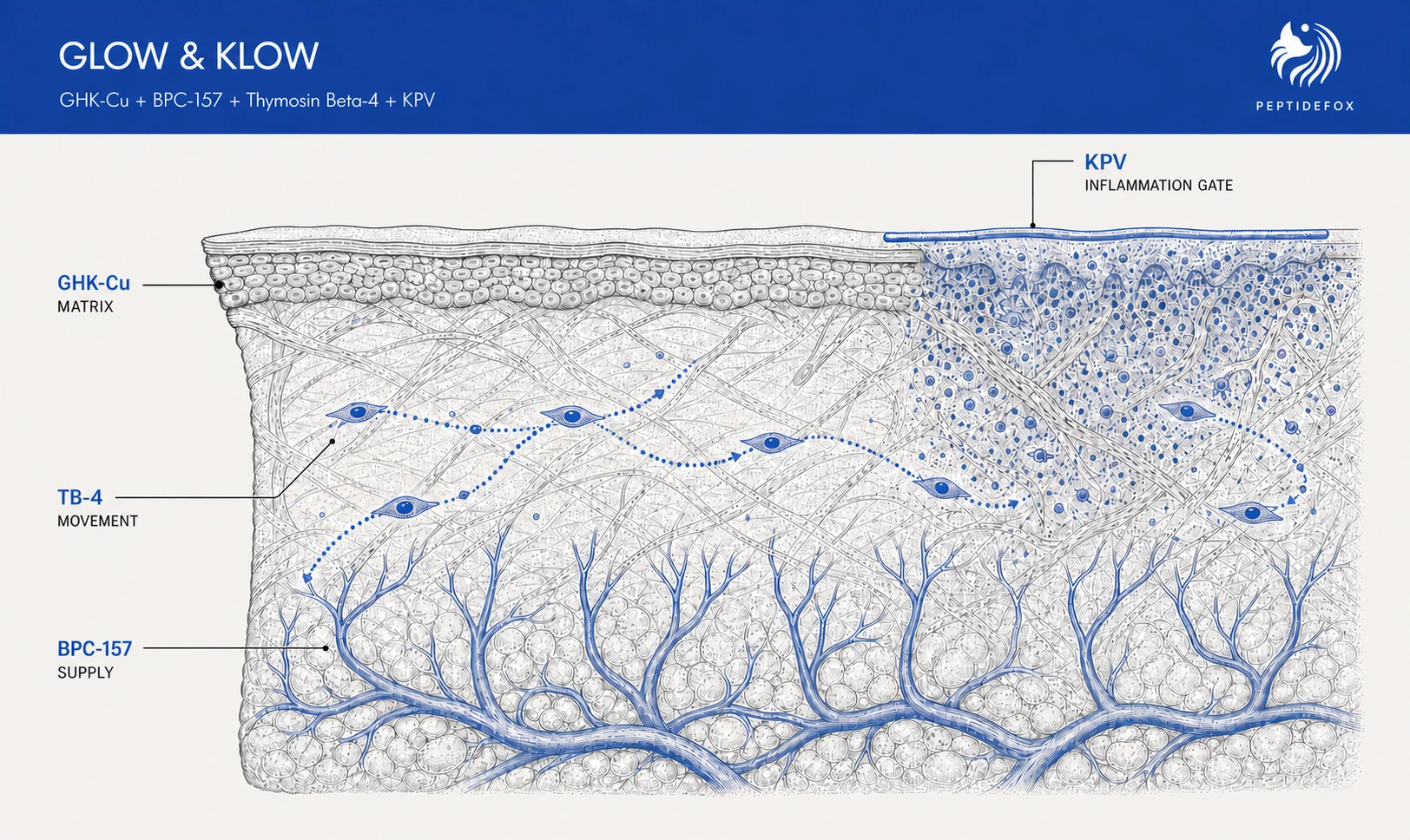
Both blends divide skin repair across three connected jobs:
- GHK-Cu rebuilds collagen and clears damaged tissue at the same time. Its copper supports the cross-linking that gives the new matrix strength.¹
- BPC-157 sprouts new small blood vessels into the dermal repair area, supplying the oxygen and nutrients needed while remodeling is active.²
- TB-4 moves repair cells into position and supports organized healing by keeping actin available for cell movement.³
GHK-Cu: collagen building and repair
GHK-Cu is a three-amino-acid peptide bound to copper. It changes which repair instructions skin cells follow, increasing collagen, elastin, and antioxidant production while helping clear damaged tissue. Its copper also supports lysyl oxidase, the enzyme that cross-links new collagen fibers and gives the matrix strength (gene regulation, tissue clearing, and collagen cross-linking¹).
GHK-Cu carries most of the matrix-building work in both blends. The practical targets are firmness, elasticity, finer texture, and more organized remodeling of scarred or sun-damaged tissue.
BPC-157: blood supply to the repair area
BPC-157 is a synthetic 15-amino-acid peptide modeled from a protective protein fragment found in gastric juice. It signals blood-vessel cells to relax existing vessels, move into damaged tissue, and form new capillaries. In tendon repair cells, it also increased the number of places where growth hormone can attach; it made the cells more responsive when growth hormone was present without activating the signal on its own (new blood vessel formation²).
BPC-157 does not build collagen directly. It supports the capillary supply that brings oxygen and nutrients into active tissue while GHK-Cu and TB-4 do their repair work.
TB-4: repair-cell movement and tissue organization
TB-4 is a naturally occurring 43-amino-acid peptide involved in cell movement and tissue repair. Repair cells move by building and releasing an internal scaffold made from actin. TB-4 holds loose actin in reserve so the scaffold can be assembled where it is needed (actin sequestration³).
TB-4 can also release Ac-SDKP, a smaller peptide studied for anti-scarring and anti-inflammatory effects. Its role complements GHK-Cu: TB-4 helps position the repair cells, while GHK-Cu handles more of the matrix-building work. TB-4 is not the same molecule as TB-500, the shorter 17–23 fragment, even when product labels use the names interchangeably.³ ⁵
The shared three-peptide rationale is mechanistic. No controlled study has tested the specific GHK-Cu-heavy ratio used in GLOW or KLOW.
What KPV Changes in KLOW
KPV is a three-amino-acid fragment of alpha-MSH and the only compound unique to KLOW. It limits NF-κB-related inflammatory signaling, lowering the production of inflammatory molecules in cell and animal models.⁴
KPV blocks the inflammation switch before that signal reaches the cell nucleus. This does not eliminate the early inflammation needed to start repair; it is intended to stop persistent signaling from continuing to break down tissue.
KPV does not add another collagen-building signal. It adds an inflammation-control layer so persistent redness or reactivity is less likely to overwhelm the shared repair work of GHK-Cu, BPC-157, and TB-4. KLOW is therefore the more complete fit when inflammation is part of the skin baseline. When skin is calm, KPV may not solve an active bottleneck.
GLOW vs. KLOW: Which One Fits Which Goal?
When to use KLOW
KLOW fits when skin repair and inflammatory control need to happen together:
- Rosacea-pattern redness or frequent flushing
- Reactive skin that becomes irritated easily
- Post-procedure redness after laser, microneedling, or similar treatments
- Inflammatory acne or another skin goal where persistent inflammation is part of the picture
KLOW does not have controlled human evidence for these uses as a pre-mixed blend. The selection is based on KPV’s mechanism and the role persistent inflammation can play in slowing repair.
When to use GLOW
GLOW fits when skin is calm and the goal is centered on remodeling:
- Firmness and elasticity
- Fine lines
- Texture and general skin quality
- Scar or sun-damage remodeling without a reactive-skin baseline
GLOW contains the same GHK-Cu, BPC-157, and TB-4 base as KLOW. It leaves out KPV because inflammation control is not the primary job.
Is KLOW better than GLOW?
KLOW is not universally better than GLOW. KLOW is the better fit when persistent inflammation is part of the skin problem. GLOW is the more direct fit when skin is calm and the goal is firmness, fine lines, texture, or general remodeling.
Evidence Behind GLOW and KLOW
No clinical study has compared GLOW with KLOW. No clinical study has tested either fixed-ratio blend as a combined intervention. The evidence comes from the individual compounds:
- GHK-Cu: Gene-expression and wound-healing research support matrix remodeling. Small human cosmetic studies report changes in wrinkle depth and skin density, but the strongest human evidence is topical.¹
- BPC-157: Cell and animal models support blood-vessel signaling and repair-cell effects. Human evidence remains thin and does not establish a skincare outcome from injected GLOW or KLOW.²
- TB-4: Wound-healing models and broader repair research support the mechanism. Those findings do not establish the effect of TB-4 inside either blend.³ ⁵
- KPV: Cell and animal models support anti-inflammatory effects. The strongest route-specific work uses oral delivery into inflamed gut tissue, not SubQ delivery for human skin.⁴ ⁶
The evidence does not transfer cleanly across dose, route, or formulation. Topical GHK-Cu data does not establish the effect of injected GLOW or KLOW. Oral KPV delivery into inflamed gut tissue does not establish what SubQ KPV does in skin. Full-length TB-4 research cannot be assigned to a TB-500 fragment vial.
Regulatory Status
Neither KLOW nor GLOW has an FDA-approved therapeutic indication. FDA’s compounding review applies to the individual ingredients, not to either blend as a finished formulation.
GHK-Cu
- Injectable GHK-Cu was moved to Category 2 in September 2023.
- GHK-Cu will return to PCAC for a vote before the end of February 2027.
- HHS has announced that GHK-Cu is expected to return to Category 1, which would restore the compounding pathway for injectable formulations.⁷
BPC-157
- On July 23, 2026, PCAC voted to recommend adding BPC-157 to the 503A Bulk Drug Substances List.
- Final FDA action on BPC-157 is still pending.⁷
TB-4
- The July 23, 2026 PCAC recommendation covered TB-500, not the full-length TB-4 used in GLOW and KLOW.
- The TB-500 recommendation does not change the status of TB-4 because the two are different molecules.⁷
KPV
- On July 23, 2026, PCAC voted to recommend adding KPV to the 503A Bulk Drug Substances List.
- KPV appears only in KLOW, so its compounding status does not change GLOW’s three-compound formulation.
- Final FDA action on KPV is still pending.⁷
These updates concern compounding access for the individual ingredients. A PCAC recommendation is not a rule, and a category change would not constitute FDA approval or create blend-level efficacy data.
Are GLOW or KLOW Injury Stacks?
GLOW and KLOW are built around skin-remodeling goals, not structural injury rehabilitation. KLOW adds KPV, but neither blend replaces a purpose-built injury stack. The Wolverine Stack guide covers the BPC-157 and TB-500 framework used for tendon, ligament, and muscle-repair goals.
GLOW and KLOW Dosage and Protocols
Once the blend has been selected, the operational details belong on the dedicated dosing pages:
- KLOW peptide dosage, protocol, reconstitution, and calculator
- GLOW peptide dosage, protocol, reconstitution, and calculator
Those pages cover vial-specific math, BAC water, syringe units, frequency, and cycle structure. The comparison page keeps the choice between the two blends separate from the dose calculation.
FAQ
What is the difference between GLOW and KLOW?
KLOW contains GHK-Cu, BPC-157, TB-4, and KPV. GLOW contains GHK-Cu, BPC-157, and TB-4. KPV is the only compound unique to KLOW, adding an inflammation-control layer for reactive or inflammation-driven skin.
Is KLOW the same as GLOW with KPV?
KLOW uses the same 50 mg GHK-Cu, 10 mg BPC-157, and 10 mg TB-4 base as a standard GLOW-70 blend, then adds 10 mg KPV. That produces the standard 80 mg KLOW blend.
Which is better for rosacea-pattern or reactive skin?
KLOW is the better mechanistic fit for rosacea-pattern redness or reactive skin because it includes KPV. KPV limits NF-κB-related inflammatory signaling in cell and animal models. No controlled human study has tested KLOW for rosacea.
Which is better for fine lines and firmness?
GLOW is sufficient when skin is calm and the goal is fine lines, firmness, elasticity, or texture. KLOW contains the same repair base, but its additional KPV is most relevant when inflammation is also part of the picture.
Can GLOW and KLOW be used together?
Using GLOW and KLOW together duplicates GHK-Cu, BPC-157, and TB-4. The meaningful difference is whether KPV belongs in the blend. The dedicated KLOW dosing page and GLOW dosing page cover operational details after that choice is made.
What does GLOW 70 vs. KLOW 80 mean?
GLOW-70 contains 70 mg total: 50 mg GHK-Cu, 10 mg BPC-157, and 10 mg TB-4. KLOW-80 contains those same three amounts plus 10 mg KPV, for 80 mg total.
Are GLOW and KLOW FDA approved?
Neither GLOW nor KLOW is FDA approved as a pre-mixed blend. FDA’s current compounding review concerns the individual ingredients and the 503A access pathway. A PCAC recommendation or category change does not approve either blend or establish that it works.
Related Topics
- KLOW peptide dosage and protocol
- GLOW peptide dosage and protocol
- GHK-Cu for skin
- KPV guide
- BPC-157 guide
- TB-500 and TB-4 guide
References
¹ GHK-Cu gene modulation — collagen gene activation, lysyl oxidase cross-linking, antioxidant expression, and broad gene modulation: Pickart L, Margolina A. Int J Mol Sci 2018. DOI: 10.3390/ijms19071987; Pickart L. J Biomater Sci Polym Ed 2008. PubMed: 18644225
² BPC-157 blood-vessel signaling — nitric-oxide signaling, VEGF-related pathways, and growth-hormone receptor expression in cell and animal models: Hsieh MJ et al. Sci Rep 2020. DOI: 10.1038/s41598-020-74022-y; Huang T et al. Drug Des Devel Ther 2015. DOI: 10.2147/DDDT.S82030; Chang CH et al. Molecules 2014. PMC6271067
³ TB-4 tissue repair — actin sequestration, cytoskeletal organization, and Ac-SDKP release: Goldstein AL et al. Trends Mol Med 2005. PubMed: 16099219; Xue B et al. Proc Natl Acad Sci 2014. PMC4217450
⁴ KPV anti-inflammatory mechanism — NF-κB-related signaling, cytokine suppression, and immune-cell effects in cellular and animal models: Luger TA, Brzoska T. Ann Rheum Dis 2007. PubMed: 17934097; Getting SJ, Schiöth HB, Perretti M. J Pharmacol Exp Ther 2003. PubMed: 12750433
⁵ TB-4 wound healing — dermal repair acceleration with TB-4 in wound models: Malinda KM et al. J Invest Dermatol 1999. PubMed: 10469299
⁶ KPV oral delivery via PepT1 — transporter uptake and inflammatory signaling in murine intestinal models: Kannengiesser K et al. Inflamm Bowel Dis 2008. PubMed: 18092346; Dalmasso G et al. Gastroenterology 2008. PMC2431115
⁷ FDA compounding-pathway status — the 503A bulk drug substances process, the July 23–24, 2026 PCAC agenda for BPC-157, KPV, and TB-500, route-specific questions for injectable GHK-Cu, and the planned GHK-Cu review: FDA 503A bulk drug substances update; July 23–24, 2026 PCAC meeting; FDA safety-risk list; FDA PCAC meeting schedule
Medical Disclaimer
The content in this protocol guide is for informational purposes only and does not constitute medical advice. Always consult with a qualified healthcare provider before beginning any new protocol, supplement, or medication.