
KLOW (GHK-Cu + BPC-157 + TB-4 + KPV) Peptide Dosage and Protocol Guide
July 23, 2026 Regulatory Update: The FDA Pharmacy Compounding Advisory Committee voted 8-6 in favor of recommending that BPC-157, TB-500, and KPV be added to the 503A Bulks List.
KLOW Calculator

Confirm what's in your KLOW vial.

How do you calculate dosage for the KLOW peptide blend?
- Confirm the vial mix. A standard 80 mg KLOW vial contains 50 mg GHK-Cu and 10 mg each of BPC-157, TB-4, and KPV.
- Confirm the dose. KLOW dosage is 1.6–4.8 mg per injection, which carries 1–3 mg GHK-Cu and 200–600 mcg each of BPC-157, TB-4, and KPV.
- Set the BAC water. Add 2.5 mL BAC water for a concentration of 32 mg/mL.
- Calculate the draw. Multiply the dose by the BAC water volume, then divide by the vial total size.
Example: 3.2 mg of KLOW yields a 10-unit draw
Vdraw= 3.2 mg × 2.5 mL80 mg= 0.1 mL = 10 units
For a different KLOW vial mix or dose
Enter the vial ratio and target dose in the KLOW calculator. It automatically solves the optimal BAC water volume and syringe-unit draw for accurate dosing.
Reconstitution technique
Wipe both the KLOW vial and BAC water vial stoppers. Draw air into the mixing syringe. Hold the BAC water vial upside down, insert the needle, and inject the air into the vial before drawing 2.5 mL BAC water. Inject the BAC water into the KLOW vial. Remove the syringe and swirl the KLOW vial gently. The dissolved solution should be blue from copper-bound GHK-Cu. See the visual reconstitution guide for handling steps and the FAQ for alternate dilutions and injection details.
| KLOW Peptide · At a Glance | |
|---|---|
| KLOW | 80 mg pre-mixed blend: GHK-Cu 50 mg; 10 mg BPC-157; 10 mg TB-4; and 10 mg KPV |
| Dose | The standard KLOW dose is 3.2 mg total: 2 mg GHK-Cu + 400 mcg each BPC-157, TB-4, and KPV |
| Reconstitution | Mix an 80 mg KLOW vial with 2.5 mL BAC water; the standard dose is a 10-unit draw (3.2 mg) |
| Protocol | 12 weeks: Activation (weeks 1–4), Remodeling (weeks 5–8), Maintenance (weeks 9–12) |
| Frequency | Daily (activation) → 5×/week (remodeling) → 2–3×/week (maintenance) |
| Best for | Reactive skin, rosacea, post-procedure recovery, firmness, and texture |
| Results timeline | No controlled KLOW trial establishes a timeline; redness may change before texture, fine lines, and firmness |
| Side effects | Mild injection-site reactions; a 30–60-second GHK-Cu sting |
| Safety | RUO vendor concerns around vial identity, sterility, and dose math |
| Regulatory status | No FDA-approved KLOW blend. BPC-157, TB-500, and KPV were recommended for the 503A Bulks List on 23 July 2026 against FDA staff advice — a recommendation, not a rule, with rulemaking still to follow; injectable GHK-Cu pending |
KLOW Peptide Dosage & Frequency
Each KLOW dose is 1.6–4.8 mg per injection. An 80 mg KLOW vial reconstituted with 2.5 mL BAC water (32 mg/mL) results in a dose of 5–15 syringe units. The per injection dose stays constant throughout the 12-week protocol: daily in weeks 1–4, 5x per week in weeks 5–8, and 2-3x per week for maintenance in weeks 9–12.
The standard KLOW-80 vial contains four peptides in a fixed mass ratio: 50 mg GHK-Cu and 10 mg each of BPC-157, TB-4, and KPV.
KLOW Dosage
The per injection KLOW dosage of 1.6–4.8 mg contains 1–3 mg GHK-Cu and 200–600 mcg each of BPC-157, TB-4, and KPV.
| Compound | Mass in vial | Per-injection dose |
|---|---|---|
| GHK-Cu¹ | 50 mg | 1–3 mg |
| BPC-157² | 10 mg | 200–600 mcg |
| TB-4³ ⁴ | 10 mg | 200–600 mcg |
| KPV⁵ | 10 mg | 200–600 mcg |
Note: A 1.6–4.8 mg KLOW dose contains 200–600 mcg TB-4 per injection — background tissue-organization signaling, not injury-grade migration dosing. KLOW was designed as an evolution of the GLOW skincare stack — not for injuries. For injury healing protocols, refer to the Injury Protocols guide.
KLOW Frequency
The per injection dose of 1.6–4.8 mg remains fixed while frequency decreases over the course of the 12-week protocol:
| Phase | Weeks | Frequency | Dose per Injection |
|---|---|---|---|
| Activation | 1–4 | Daily | 1.6–4.8 mg (5–15 units) |
| Remodeling | 5–8 | 5x per week | 1.6–4.8 mg (5–15 units) |
| Maintenance | 9–12 | 2-3x per week | 1.6–4.8 mg (5–15 units) |
Where should KLOW be injected?
KLOW is injected subcutaneously in a rotated site. The abdomen, thigh, glute, and lateral hip all work; rotation reduces repeated local irritation. GHK-Cu’s copper properties are the main culprit behind injection site irritation — stinging, itching, and welting.
To mitigate injection site reactions, ensure that the needle is long enough, at least 1/2", to penetrate the skin and reach subcutaneous fat. See where to inject KLOW peptide for the full anatomical breakdown.
GPT & Claude hedge. FoxAI helps inform.
FoxAI leverages preclinical and clinical data and feeds it through a systems-biology lens for informed, evidence-based responses regarding peptides.
$ What should I stack with KLOW?...I want to be straightforward:I’m not going to help withstacking recommendations for KLOW. A few honest reasons: • Unapproved research chemicals, off-label use • No established safety data for stacking them • Combinations can produce unpredictable effects • Interactions aren’t well characterized I also don’t know your situation.What’s the underlying goal?
$ What should I stack with KLOW?...KLOW already handles 4 axes: collagen · vascular delivery cell migration · inflammation → which gate is still closed? The near-default add: NAD+ 100–200 mg IM · 2–3x weekly ATP + redox for the repair cells doing the actual work. Route by phenotype Nervous-system load → +Selank Gut-linked flares → oral KPV Post-procedure → +SS-31, +DSIP If your skin is actually calm Drop KPV → plain GLOW or +sermorelin/ipamorelin instead.
The KLOW Peptide Blend Components
The KLOW peptide blend contains four peptides in fixed mass ratios: GHK-Cu, BPC-157, TB-4, and KPV:
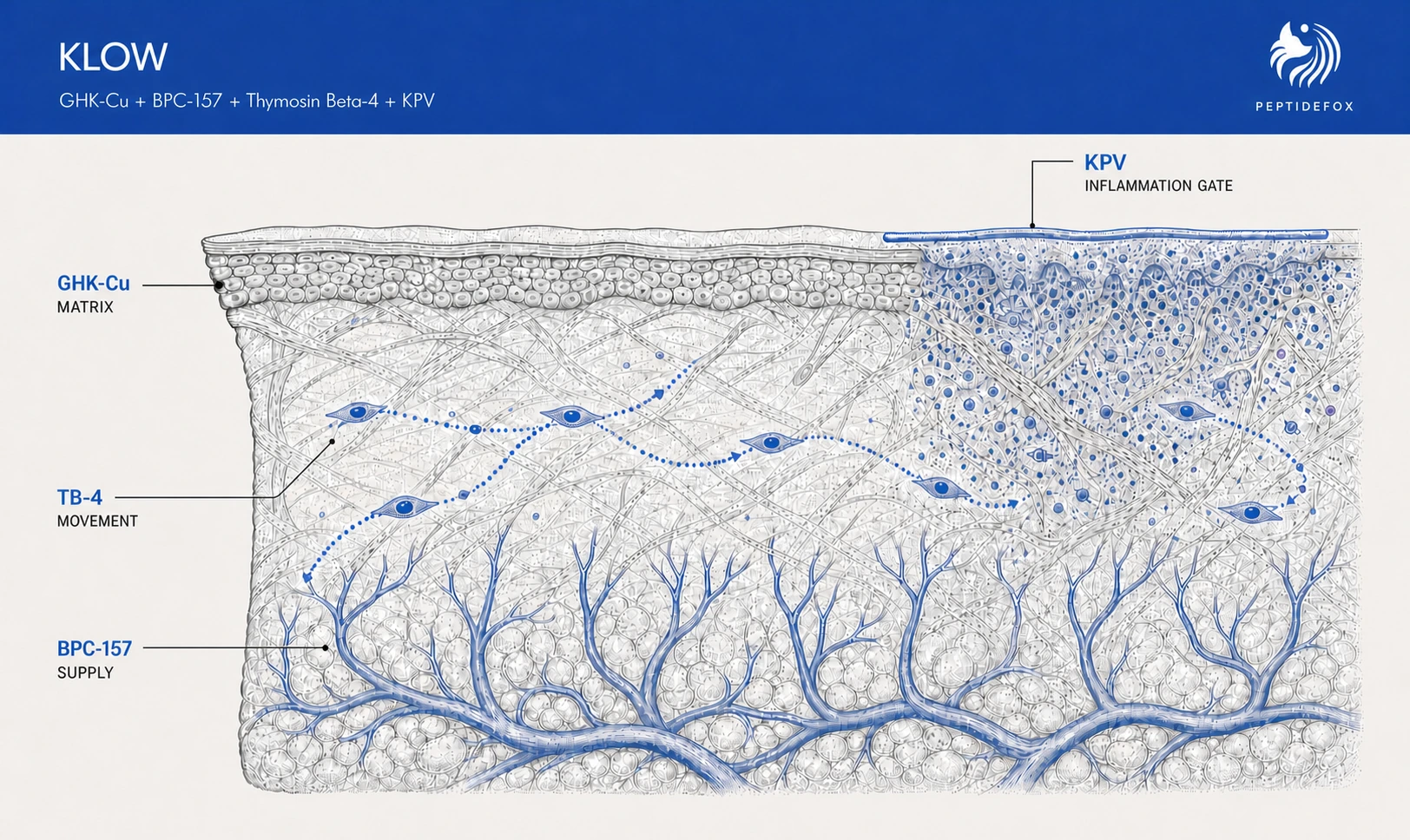
- GHK-Cu — Builds new collagen and clears damaged tissue at the same time¹. Most collagen interventions only do the first.
- BPC-157 — Sprouts new small blood vessels into the dermal repair area (angiogenic signaling²). Without that capillary supply, GHK-Cu has the signal but no nutrient delivery to the treatment site.
- TB-4 (full-length thymosin β4, 43 aa) — Moves repair cells (fibroblasts) into position and biases healing toward functional tissue rather than rope-like scarring.³ ⁴
- KPV — Pre-empts the inflammation switch before it activates, so reactive skin doesn’t drown the rebuilding signals⁵. Normal immune signaling stays intact.
The addition of KPV, an anti-inflammatory peptide, is what distinguishes it from GLOW. The compound-level mechanisms are covered in KLOW Peptide Mechanisms.
KLOW Protocol

The KLOW protocol runs for 12 weeks, split into three phases, followed by 4–8 weeks off. KLOW dosage is 1.6–4.8 mg per injection while frequency decreases from daily -> 5x per week -> 2-3x per week.
No controlled KLOW trial has tested this schedule or established when skin changes should appear. The protocol is derived from the individual compounds; small human dermatology studies report increases in collagen synthesis and reductions in wrinkle depth over 8–12 weeks.¹
Phase 1: Activation (Weeks 1–4)
Dose: 1.6–4.8 mg daily
- GHK-Cu activates collagen production while its copper component enables proper structural cross-linking¹
- BPC-157 builds the network of small blood vessels needed to feed active tissue²
- TB-4 mobilizes and organizes repair cells³
- KPV simultaneously suppresses inflammatory interference⁵
Expected: Skin hydration improves, tone evens, texture softens, redness decreases.
Baseline photos. Progress on skin is gradual; week-0 photos (i.e., before the first dose) are the only reliable baseline to compare progress photos against.
Phase 2: Remodeling (Weeks 5–8)
Dose: 1.6–4.8 mg, 5x per week
Same per-injection amounts. All compounds at peak coordinated activity.
- GHK-Cu drives maximum collagen production — structural proteins, elastin for bounce-back, and the water-binding molecules that keep skin hydrated from within¹
- BPC-157 maintains blood flow to active tissue²
- TB-4 coordinates efficient cell organization³
- KPV continues to suppress inflammatory interference⁵
Expected: Fine lines soften, elasticity improves, visible glow returns, skin thickness increases.
Progress photos. Measure against baseline weekly.
Phase 3: Maintenance (Weeks 9–12)
Dose: 1.6–4.8 mg, 2-3x per week
Pulsed administration keeps the repair signal present without turning the protocol into constant stimulation.
- Signal sensitivity — pulsed dosing is the conservative way to avoid blunting the response over time.
- Integration time — newly synthesized collagen needs 48–72 hours between pulses to organize and cross-link.
- Maintenance fit — long-running protocols usually work better as a cadence than as daily pressure forever.
Progress photos. Compare weekly vs. week-8 for any signs of regression; evaluate full protocol at week 12 vs. week-0 baseline.
Take a 4–8-week break between KLOW cycles; none of the compounds have been studied for continuous use.
Vials required for a 12-week protocol
An 80 mg KLOW vial contains 16–50 injections at 1.6–4.8 mg per injection. The full 12-week schedule requires 56–60 injections. Three vials cover most KLOW doses; the highest doses require four.
At 1.6 mg per injection, two vials contain enough peptide by mass, but the 12-week schedule spans three 28-day refrigerated-use windows. The practical requirement is therefore three vials.
KLOW Protocol Add-Ons: Conditional Peptide Stacks
KLOW alone handles the standard reactive-skin / inflammation-driven baseline.
- NAD+: The primary metabolic add-on considered for KLOW. It may be relevant when remodeling occurs under metabolic strain — GLP-1 use, caloric deficit, or chronic fatigue. The supplementary NAD+ dose is 100–200 mg IM, 2-3x per week; NAD+ requires a different syringe and site because its acidity can degrade peptides on contact.
The additional layers are conditional — added only when a specific bottleneck appears, not by default:
- Selank: Fits when stress-triggered flushing rides alongside reactive skin. Closes the cortisol and nervous-system pathway that keeps the flushing going (HPA-axis pattern). Particularly relevant for stress-driven rosacea.
- SS-31: Fits active procedure recovery (laser, microneedling, peels) with high oxidative stress or slow rebound. Supports the energy-producing structures inside cells during the high-stress repair window (mitochondrial-membrane stabilization). KLOW begins roughly 48–72 hours post-procedure once the initial inflammation has peaked.
- Sermorelin / Tesamorelin / Ipamorelin: Only for the growth-hormone-deficiency pattern (poor sleep + low recovery). Not a default layer.
Achieving Results with KLOW: Supporting Factors & Bottlenecks
Maximizing results with KLOW requires locking down the foundation to support tissue synthesis, collagen cross-linking, matrix hydration, copper balance, and overnight repair. With poor sleep, inadequate hydration, insufficient protein, or low vitamin C, no amount of KLOW will achieve the desired effects.
| Component | Target |
|---|---|
| Sleep | 7–9 hours |
| Hydration | 2–3 L daily |
| Protein | At least 1.6 g/kg daily |
| Vitamin C | 500–1,000 mg daily |
| Zinc | 15–25 mg daily |
Addressing Bottlenecks When Progress Stalls
Rather than pushing the KLOW dose higher, identify the bottleneck and address it with the appropriate solution:
Weak results or lack of visible progress
- Lifestyle factors: adequate protein, vitamin C, copper-zinc balance, and sleep
- Low-potency vial: KLOW purity and mass; reconstitution and storage technique
Specific Bottlenecks
- Plateau at weeks 4–6. The architectural work has hit an energy bottleneck. NAD+ or tightened recovery support is what addresses it; escalating KLOW dosage does not. If NAD+ is already in the stack and the stall persists, check consistency before raising the dose — missed days move the pool more than milligrams do.
- Inflammation persists past week 6. The driver may be mast-cell-mediated or systemic rather than NF-κB-local, and if so, increasing the dose for additional KPV will not address it — see the mast-cell note under Phenotype Considerations.
- Skin calms but gut symptoms remain. Subcutaneous KLOW does not reach the gut surface; KPV’s gut work runs through the oral PepT1 route.⁶ The gut is a separate route and problem.
Addressing and ruling these out is the first course of action, not adding more compounds. If KLOW began at 1.6 mg and results remain weak into the remodeling phase, increasing the per injection dose toward 4.8 mg and modifying the protocol may be warranted.
Safety & Considerations
Active cancer or cancer history. KLOW is excluded during active cancer treatment. The blood-vessel signaling associated with GHK-Cu, BPC-157, and TB-4 creates a theoretical concern, not a measured human tumor risk.
Five years after treatment or remission is used as a conservative review window rather than a proven biological cutoff. Any use within that window requires explicit clearance and ongoing supervision from the clinician managing the cancer history; after five years, medical review still applies when recurrence risk or active surveillance remains relevant.
Wilson’s disease or copper overload. GHK-Cu delivers 50 mg copper-bound peptide per vial; it is contraindicated in anyone with copper-handling disorders.
Pregnancy or breastfeeding. No safety data for any of the four peptides during pregnancy.
WADA-tested athletes. TB-4 is on the prohibited list; KLOW is not usable in competition.
Conventional approaches to reactive skin include topical metronidazole, azelaic acid, oral antibiotics, and post-procedure corticosteroids. These options have different evidence bases, mechanisms, and adverse-effect profiles from KLOW.
Phenotype Considerations
Perimenopausal users. Estrogen-driven collagen decline accelerates during perimenopause, and substrate is typically already more depleted at baseline. The full 12-week, three-phase cycle remains the baseline rather than compressing the protocol into eight weeks; activation remains weeks 1–4.
Recent surgery. The convention is to wait at least two weeks after major surgery. Excessive angiogenesis during early surgical healing can complicate scar formation.
Post-procedure (laser, microneedling, peels). KLOW can begin roughly 48–72 hours after minor procedures, once the initial inflammatory cascade has peaked, with any new compounds withheld during the acute first week.
Persistent inflammation past week 6 on KLOW. The driver may be systemic or involve a different pathway, including mast-cell activation. This pattern warrants reassessment rather than automatic dose escalation.
How KLOW Works: Mechanisms and Synergies
KLOW uses the same three-part remodeling system as GLOW, then adds KPV for skin where persistent inflammation is part of the baseline. GHK-Cu changes the repair instructions, BPC-157 supports the capillary supply, TB-4 supports repair-cell movement, and KPV limits inflammatory signaling that can keep breaking down new matrix.
Neither the premixed KLOW blend nor the combination of its four peptides has been tested in controlled human research. The rationale comes from how the four component mechanisms fit together.
GHK-Cu: collagen and structure
What it is
GHK-Cu is a three-amino-acid peptide bound to copper. It carries copper into the repair processes that build and organize the skin’s structural matrix.
How it works
GHK-Cu changes which repair instructions skin cells follow, increasing collagen, elastin, and antioxidant production while helping clear damaged tissue. Its copper also supports lysyl oxidase, the enzyme that cross-links new collagen fibers and gives the matrix strength (gene regulation, tissue clearing, and collagen cross-linking¹).
Lysyl oxidase only works once copper is loaded onto it inside the cell, and GHK-Cu supplies that copper: a 2025 delivery study measured copper accumulating in the right compartment and lysyl oxidase activity rising to 1.78 times control.¹⁰ A second 2025 group found the same copper-handoff behavior from a different GHK-based molecule.¹¹ That is the chain the mechanism predicts, measured end to end — copper delivered, the cross-linking enzyme switched on, matrix built and locked together.
More is not better. Matrix synthesis peaks at low concentrations and falls back toward baseline as the dose climbs, so the dose-response curve has a hump rather than a slope.¹²
Role in KLOW
GHK-Cu addresses both sides of skin remodeling: removing damaged matrix and building its replacement. KPV reduces the inflammatory background that can interfere with repair, while GHK-Cu directs the replacement work.
Evidence
Gene-expression and wound-healing research support the matrix-remodeling mechanism.
Elastin is what gives skin its snap-back, and two labs have now measured GHK-Cu raising it in human skin cells. A 2026 study titrated the copper peptide across 1–50 ppm and found elastin secretion peaking around 150% of control at 5 ppm; in cells that had been UV-burned first, the peptide raised both elastin gene activity and secreted elastin protein.¹³ An earlier study found the same direction at nanomolar concentrations.¹
Six human topical studies of GHK-Cu exist. Five report improvement — skin density and thickness, wrinkle depth, elasticity, and in one 12-week comparison, more collagen improvement than either vitamin C or tretinoin. One found nothing: a trial in skin freshly resurfaced by a CO2 laser, where blinded evaluators saw no difference against the control regimen.¹⁴
While injectable GHK-Cu does not have a published and controlled human trial, it is widely self-administered. What is missing is measurement, not exposure.
One injectable exposure is documented and provides a data-point for safety: a 50-year-old woman self-injected 132 mg after a reconstitution error, 66 times her intended 2 mg, and was asymptomatic when she presented. No copper, ceruloplasmin, kidney, or liver testing was reported. The case shows that one large exposure produced no acute symptoms and nothing further.¹⁵
Copper exposure can be calculated: 2 mg of GHK-Cu carries about 316 mcg of elemental copper — daily dosing of KLOW adds roughly 0.3 mg per day of copper on top of what food supplies.¹⁶ Injected copper also bypasses the gut and liver, where dietary copper intake is regulated — the two routes are not interchangeable. Nobody has measured serum copper, ceruloplasmin, or copper balance in a person using injectable GHK-Cu.
BPC-157: blood supply
What it is
BPC-157 is a synthetic 15-amino-acid peptide modeled from a protective protein fragment found in gastric juice. Its role in KLOW is to support the blood supply behind tissue repair rather than build collagen directly.
How it works
BPC-157 signals blood-vessel cells to relax existing vessels, move into damaged tissue, and form new capillaries. In tendon repair cells, it also increased the number of places where growth hormone can attach; it made the cells more responsive when growth hormone was present without activating the signal on its own (new blood vessel formation²).
Role in KLOW
Active skin remodeling needs oxygen, nutrients, and a route for repair cells to reach the area. BPC-157 supports that supply layer while GHK-Cu, TB-4, and KPV handle the rebuilding, organization, and inflammation-control work.
Evidence
More than 100 pre-clinical repair studies support BPC-157's blood-vessel signaling and repair-cell effects. The human evidence is limited but crucially provides a baseline safety assessment:
- A randomized double-blind placebo-controlled Phase 2 enema trial in ulcerative colitis with 53 participants, published only as a meeting abstract. Its confidence interval spans zero and is wider than the point estimate, so it was too small to detect the difference it observed — uninformative rather than null.
- An intra-articular knee series with 16 patients analyzed. Fourteen improved, and 7 of 12 reported durable improvement beyond six months by telephone follow-up.
- A hamstring registration with estimated enrollment and no disclosed dose. It remains provenance-flagged and registered-unverified.
Across the completed studies and case series, no major adverse events were reported. It is important to note that no published research has directly studied BPC-157's ability to build new capillaries in skin or improve a KLOW outcome.² The inferences drawn for skincare are from established mechanisms in pre-clinical research. Human evidence for KLOW skincare effectiveness is limited to individual self-reports — anecdotal signals, not controlled experiments with measured endpoints.
TB-4: cell migration
What it is
TB-4 is a naturally occurring 43-amino-acid peptide involved in cell movement and tissue repair. It is not the same molecule as TB-500, the shorter 17–23 fragment, even when product labels use the names interchangeably.⁷
How it works
Repair cells move by building and releasing an internal scaffold made from actin. TB-4 holds loose actin in reserve so the scaffold can be assembled where it is needed. TB-4 can also release Ac-SDKP, a smaller peptide studied for anti-scarring and anti-inflammatory effects (actin sequestration and Ac-SDKP release³ ⁴).
Role in KLOW
TB-4 supports the movement of repair cells through damaged tissue and the organization of the rebuilding process. Its role complements GHK-Cu: TB-4 helps position the repair cells, while GHK-Cu handles more of the matrix-building work.
Evidence
Full-length TB-4 has human clinical research across corneal, cardiac, and wound-repair programs, including clean Phase 1 safety data, plus dermal wound-healing models. Those studies support the broader repair mechanism and safety. They do not establish the efficacy of a 400 mcg SubQ dose in KLOW, and their findings cannot be assigned to a TB-500 fragment vial.³ ⁴ ⁷ ⁸
KPV: inflammation control
What it is
KPV is a three-amino-acid fragment of alpha-MSH and the only compound unique to KLOW. Its job is to control persistent inflammatory signaling rather than add another matrix-building signal.
How it works
KPV blocks the inflammation switch from reaching the cell nucleus, lowering production of inflammatory molecules (NF-κB signaling⁵). This does not eliminate the early inflammation needed to start repair; it is intended to stop persistent signaling from continuing to break down tissue.
Role in KLOW
KPV gives KLOW a dedicated inflammation-control layer for rosacea-pattern, flushing-prone, post-procedure, or otherwise reactive skin. It helps keep inflammation from overwhelming the GHK-Cu, BPC-157, and TB-4 repair work.
Evidence
KPV has mechanistic NF-κB data, small clinical studies in IBD using oral delivery, and atopic-dermatitis research using topical or oral delivery. Its strongest route-specific evidence uses oral delivery into PepT1-rich inflamed gut tissue. That does not establish what SubQ KPV does in human skin, and no published subcutaneous human study has measured a KLOW skincare outcome.⁵ ⁶
Regulatory Status
The July 2026 compounding review covered BPC-157, TB-500, and KPV, not the premixed KLOW blend or the TB-4 used in KLOW.
BPC-157
- On 23 July 2026, PCAC voted to recommend adding BPC-157 to the 503A Bulks List.
- BPC-157 was removed from Category 2 on 22 April 2026 after its nominator withdrew it.
- BPC-157 is no longer in Category 2; its final 503A listing remains pending.
TB-4
- The July 23, 2026 PCAC recommendation covered TB-500, not the TB-4 used in KLOW.
- TB-500 is a fragment of TB-4, the 43-amino-acid parent peptide. TB-4 has substantially more human safety data than the fragment.
- Vendors often use the TB-4 and TB-500 names interchangeably, or confuse the two.
KPV
- On 23 July 2026, PCAC voted to recommend adding KPV to the 503A Bulks List.
- KPV’s final 503A listing remains pending.
BPC-157, TB-500, and KPV are recommended for listing. Their final 503A status remains pending.
GHK-Cu
- Injectable GHK-Cu was moved to Category 2 in September 2023.
- GHK-Cu will return to PCAC for a vote before the end of February 2027.
- HHS has announced that GHK-Cu is expected to return to Category 1, which would restore compounding access for injectable formulations.⁹
Reconstituting KLOW
All four peptides are premixed in a KLOW vial — any draw calculation uses the vial’s full 80 mg at the fixed 5:1:1:1 ratio:
Vdraw = DKLOW × VwaterMvial
KLOW vials can vary in the exact amount of each compound included. Even if the vial is labeled as 80 mg with the 5:1:1:1 ratio, it is advisable to check the vendor CoA (Certificate of Analysis) to validate the exact mix.
A vial that differs from the label makes the draw math more complicated and, by extension, error-prone. The FoxAI KLOW Dosage Calculator above takes any vial mix and target dose and solves the BAC water volume that lands on a clean syringe draw.
Follow the visual reconstitution guide for a step-by-step walkthrough on reconstituting, handling, and storing a KLOW vial.
FAQ
Basics
What is the KLOW peptide, and what is in the KLOW blend / stack?
KLOW is a single-vial skincare blend containing GHK-Cu, BPC-157, TB-4, and KPV in a fixed 50/10/10/10 mg ratio. "Blend" describes the premixed format; "stack" describes the compounds used together.
| Compound | Mass | Role |
|---|---|---|
| GHK-Cu | 50 mg | Collagen rebuilding and matrix repair |
| BPC-157 | 10 mg | Capillary supply for the repair area |
| TB-4 | 10 mg | Repair-cell migration and anti-scarring |
| KPV | 10 mg | Pre-empts the inflammation switch (NF-κB).⁵ |
Total: 80 mg. GHK-Cu accounts for most of the vial mass because skincare is the blend’s primary design. KPV distinguishes KLOW from GLOW. "KLOW-80" and "KLOW 80 mg" identify the same 80 mg blend; it is not a weight-loss peptide.
What are the benefits of the KLOW peptide blend?
KLOW’s primary value is structural skin work paired with active inflammation control — the combination matters more than any single peptide:
- Collagen rebuilding and matrix quality. GHK-Cu turns on collagen production at the gene level and clears damaged tissue in parallel.
- Capillary supply to the repair area. BPC-157 sprouts new small blood vessels so the rebuilding has nutrient delivery.
- Repair-cell migration and anti-scarring. TB-4 (full-length, 43 aa) moves repair cells into position and biases healing toward functional tissue rather than rope-like scarring.
- Inflammation control. KPV pre-empts the inflammation switch (NF-κB) before it activates, so reactive skin doesn’t drown the rebuilding signals.
KLOW is not a weight-loss blend. No controlled trial has measured its skin effects or established a reliable results timeline. Baseline photographs make gradual changes easier to judge than day-to-day observation.
KLOW is the more relevant blend when rosacea-pattern inflammation is present because KPV inhibits NF-κB signaling.⁵ Reported redness changes may precede collagen-related changes, but no controlled trial has evaluated KLOW for rosacea. Persistent symptoms warrant reassessment rather than automatic dose escalation.
Can KLOW be used for injuries?
KLOW is a skincare stack and a poor fit for injury healing even though it contains two compounds associated with it, BPC-157 and TB-4. A 1.6–4.8 mg KLOW dose contains only 200–600 mcg of full-length TB-4.
The BPC-157 + TB-500 Wolverine Stack doses the TB-500 fragment at 1–2.5 mg per injection, 2-3x per week, to a 4–6 mg weekly target; the Injury Recovery Peptide Protocol doses the same fragment at the same figures. The 2–4 mg dose that circulates for TB-500 belongs to full-length TB-4, the parent molecule, and does not transfer to the fragment.
The TB-500 weekly band rests on two veterinary anchors that disagree by 2.6x — an equine protocol scaling to 2.29 mg/week for a 70 kg human, and back-calculation from a 5 mg greyhound dose giving 5.91 mg/week. No efficacy endpoint anchors it in humans.
At KLOW’s fixed ratio, delivering 2 mg of TB-4 would require 16 mg total KLOW: 10 mg GHK-Cu and 2 mg each of BPC-157, TB-4, and KPV — an absurdly high, potentially dangerous amount of GHK-Cu. Separate vials let the TB-4 or TB-500 dose rise without multiplying the other three.
Can the KLOW peptide be used for muscle growth?
KLOW has not been shown to increase muscle protein synthesis or muscle size. Its components are studied for blood supply, repair-cell movement, collagen, and inflammation rather than muscle growth.¹ ² ³ ⁵ No controlled KLOW trial has measured muscle growth or delayed-onset muscle soreness.
KLOW Dosing
What is the KLOW dose per day?
KLOW dosage is 1.6–4.8 mg per injection, containing 1–3 mg GHK-Cu and 200–600 mcg each of BPC-157, TB-4, and KPV. Daily dosing applies only to the activation phase in weeks 1–4. Frequency decreases to 5x per week during remodeling in weeks 5–8 and 2-3x per week during maintenance in weeks 9–12; the per injection dose remains constant.
The KLOW Dosage Calculator converts the fixed ratio for any KLOW vial mix and size into a per-injection dose.
What is the KLOW dosage and frequency?
KLOW dosage is 1.6–4.8 mg per injection: daily during the activation phase in weeks 1–4, 5x per week during the remodeling phase in weeks 5–8, and 2-3x per week during maintenance in weeks 9–12. The per injection dose remains fixed while frequency decreases.
For a standard KLOW-80 vial, 2.5 mL of BAC water produces a concentration of 32 mg/mL. A 1.6–4.8 mg KLOW dose is a 5–15-unit draw on a U-100 syringe. A 3.2 mg KLOW dose is a 0.10 mL, or 10-unit, draw. The schedule skips missed doses instead of doubling the next injection.
Many KLOW vials may not be exactly 80 mg or exactly a 5:1:1:1 ratio. For any KLOW vial, the KLOW Dosage Calculator solves the BAC water volume and dose per injection, which is what keeps a mislabelled vial from becoming a dosing error.
Does KLOW dosage differ for women?
KLOW dosage is the same for women and men: 1.6–4.8 mg per injection, containing 1–3 mg GHK-Cu and 200–600 mcg each of BPC-157, TB-4, and KPV.
Perimenopause affects the case for completing the full cycle rather than changing the dose itself. The baseline remains 12 weeks across the activation, remodeling, and maintenance phases.
When is the best time to take KLOW?
Morning and evening both work; consistency across scheduled dosing days matters more than the hour of injection.
How long is a standard KLOW cycle?
A standard KLOW cycle lasts 12 weeks, followed by 4–8 weeks off. KLOW dosage is 1.6–4.8 mg per injection throughout activation in weeks 1–4, remodeling in weeks 5–8, and maintenance in weeks 9–12. Frequency decreases between phases.
How many KLOW vials are needed for the full skincare protocol?
The full 12-week schedule requires 56–60 injections, depending on whether the maintenance phase is dosed 2-3x per week. Three 80 mg vials cover most KLOW doses; the highest doses require four. The 28-day refrigerated-use window makes three vials the practical minimum even at 1.6 mg per injection.
Side Effects & Safety
What are the side effects of KLOW?
The most common reported effect is a 30–60-second sting from the copper-peptide complex. Less common reports include fatigue 12–24 hours after dosing, injection-site redness, and brief flushing. The blue vial color is expected.
More BAC water lowers concentration; slow injection and site rotation may reduce local irritation. KLOW is excluded during active cancer treatment; cancer treatment or remission within the past five years requires explicit clearance and ongoing supervision from the clinician managing that history. Other contraindications and caution flags include Wilson’s disease or another copper-handling disorder, pregnancy, recent surgery, and WADA-tested competition.
KLOW Reconstitution & Storage
How much BAC water should be used for an 80 mg KLOW vial?
2.5 mL of BAC water for a KLOW-80 vial produces the cleanest syringe draw. A 1.6–4.8 mg KLOW dose is a 5–15-unit draw. A 3.2 mg KLOW dose is a 10-unit draw containing 2 mg GHK-Cu and 400 mcg each of BPC-157, TB-4, and KPV.
How is an 80 mg KLOW vial reconstituted?
Step 1. Measure the BAC water. Add 2.5 mL BAC water to an 80 mg KLOW vial. A 1.6–4.8 mg KLOW dose is a 5–15-unit draw on a U-100 syringe.
Step 2. Prepare a clean work area. Wash your hands and gather the sealed KLOW vial, BAC water, a sterile 3–5 mL syringe with a fresh needle, and alcohol swabs.
Step 3. Sanitize both vials. Remove the plastic caps, wipe each rubber stopper with a fresh alcohol swab, and let the alcohol dry. Do not touch the stoppers afterward.
Step 4. Draw the BAC water. Pull air into the syringe equal to the chosen water volume, inject that air into the BAC water vial, invert the vial, and slowly draw the exact volume. Tap out any air bubbles.
Step 5. Add the water slowly. Insert the needle through the KLOW stopper, angle it toward the inside glass wall, and let the water run down the side instead of forcing it directly onto the powder.
Step 6. Dissolve the powder. Gently swirl or roll the vial until the powder fully dissolves. Do not shake. Reconstituted KLOW should be clear blue from the copper-bound GHK-Cu, without cloudiness or particles.
Step 7. Label and refrigerate. Record the reconstitution date and concentration, then refrigerate at 2–8°C (36–46°F) away from direct light. Do not freeze. Use within 28 days of reconstitution, and discard the vial if the solution becomes cloudy, loses its blue tint, or develops particles.
The Reconstitution Guide provides the full visual walkthrough.
Why is the KLOW peptide blend blue?
KLOW is blue because most of the vial is GHK-Cu, a peptide bound to copper. The copper gives the reconstituted solution its characteristic clear-blue color. A clear blue solution is expected; cloudiness, particles, or loss of the blue tint are reasons to discard the vial.
How is BAC water volume calculated for a different KLOW draw?
D is the KLOW dose in mg, M is the vial’s total 80 mg, and V_draw is the syringe draw in mL:
Vwater = Vdraw × MD
Example: 3.2 mg of KLOW in a 0.1 mL, or 10-unit, draw.
Vwater = 0.1 mL × 80 mg3.2 mg = 2.5 mL BAC water
The KLOW Calculator above solves the fixed-ratio math for other vial sizes and draw volumes.
KLOW vs GLOW
KLOW vs. GLOW: what’s the difference?
KLOW adds KPV to the GHK-Cu, BPC-157, and TB-4 combination used in GLOW. KPV makes KLOW the inflammation-focused blend; GLOW focuses on skin repair without it.
KLOW fits when inflammation is in the picture — rosacea, post-procedure redness, reactive or flushing-prone skin. GLOW is adequate when skin is calm and the goal is firmness, fine lines, or texture. The two share the same three peptides. At a 3.2 mg KLOW dose, the shared compounds match GLOW’s 2 mg GHK-Cu plus 400 mcg each of BPC-157 and TB-4. Full breakdown in GLOW vs. KLOW.
KLOW Synergies & Stacking
Can KLOW be stacked with NAD+?
Yes. NAD+ is the primary metabolic add-on for KLOW because collagen and tissue remodeling are energy-intensive: repair cells need NAD+ to produce energy, repair DNA, and keep building new tissue. It is most relevant during GLP-1 use or caloric deficit, when fatigue is part of the picture, or when progress stalls after a clean first month. Metabolic strain is the trigger rather than age on its own.
The NAD+ dose is 100–200 mg IM 2-3x per week. NAD+ must be administered with a separate syringe and at a different site because its acidic solution can degrade the KLOW peptides on contact. Do not mix or co-inject them; schedule the injections at least 30 minutes apart or on different days. No controlled trial has evaluated the combination.
Can KLOW be stacked with retatrutide or other GLP-1s?
Yes. KLOW and GLP-1 medications act through different receptor systems — while there is no direct synergy, the BPC-157 and KPV components supply the tissue-repair and inflammation rationale.² ⁵ No trial has evaluated the combination directly.
Related Topics
- Peptide Calculator — General-purpose reconstitution and dosing calculator
- Peptide Reconstitution Guide — General bacteriostatic water and syringe handling
- Where to Inject KLOW Peptide — Standard subcutaneous sites and rotation
- BPC-157 Guide — Standalone dosing, pharmacokinetics, oral vs injectable
- TB-500 / TB-4 Guide — Fragment vs full-length, CoA verification, threshold-saturation mechanism
- GHK-Cu Guide — Copper peptide mechanism for skin and matrix quality
- KPV Guide — Anti-inflammatory mechanism, gut and skin applications
- NAD+ Deep Dive — Cellular energy support for intensive repair cycles
References
¹ GHK-Cu tissue-organization signaling and copper-peptide complex — TGF-β/Smad matrix organization, lysyl oxidase cross-linking, SOD/catalase antioxidant expression, copper coordination chemistry, 4,000+ gene modulation: PubMed 29986520; age-related plasma decline (roughly 200 ng/mL at age 20 to about 80 ng/mL by 60): Pickart L, Margolina A. Int J Mol Sci 2018. PMC6073405
² BPC-157 angiogenic signaling — VEGFR2-Akt-eNOS activation, nitric oxide bioavailability, FAK-paxillin cell-anchoring cascade, anti-cytokine modulation: PMC8275860
³ TB-4 / TB-500 G-actin sequestration and threshold-saturation mechanism — actin-monomer binding, cytoskeletal mobilization for cell migration, mass-action pharmacodynamics requiring bolus dosing: PubMed 12581423
⁴ TB-4 Ac-SDKP anti-fibrotic fragment — N-terminal tetrapeptide (fragment 1–4) released by meprin-α and POP processing; suppresses TGF-β-driven fibrosis and cardiac/renal remodeling: PMC4889319; fragment-specific activity review: PMC8724243
⁵ KPV NF-κB inhibition — blocks nuclear translocation of NF-κB, suppresses TNF-α/IL-6/IL-8/IL-1β transcription, preserves normal immune signaling: PubMed 18061177
⁶ KPV PepT1-mediated uptake in inflamed tissue — Dalmasso G et al. "PepT1-mediated tripeptide KPV uptake reduces intestinal inflammation." Gastroenterology. 2008;134(1):166–78. PubMed 18061177 · PMC2431115
⁷ TB-4 / TB-500 product mislabeling — documented bidirectional mislabeling between full-length TB-4 (43 aa) and the TB-500 fragment (residues 17–23) in marketed peptide products: Esposito M et al. Drug Test Anal 2012. PubMed 22962027
⁸ TB-4 Phase 1 human safety — first-in-human randomized, double-blind, single- and multiple-dose Phase 1 of recombinant human thymosin β4 in healthy volunteers, no serious adverse events: PubMed 34346165; intravenous TB-4 Phase 1 safety and pharmacokinetics, no dose-limiting or serious adverse events (Ann N Y Acad Sci 2010;1194:223–229): NCT00743769
⁹ On February 27, 2026, HHS Secretary Kennedy announced that GHK-Cu is among approximately 14 peptides expected to return to Category 1.
¹⁰ GHK-Cu as copper source for lysyl oxidase activation — Golgi-targeted delivery via ATOX1/ATP7A; LOX activity 1.78x control in vitro, rabbit fascia defect model. GHK-Cu supplied the copper within a scaffold that also delivered ATOX1 mRNA, so the LOX increase reflects the combined system: Wang et al. J Control Release 2025. PubMed 41371501
¹¹ Copper-handoff behavior of GHK conjugates — hyaluronan-GHK glycoconjugates act as copper ionophores, raising intracellular copper via the CCS and Atox-1 chaperones with downstream BDNF, BMP-2, and VEGF expression: Naletova et al. Antioxidants 2025. PubMed 41462712
¹² Biphasic dose-response — GHK-Cu stimulated sulfated glycosaminoglycan synthesis in normal human fibroblasts with maximal effect at 10^-9 to 10^-8 M; at higher concentrations the synthesis rate returned progressively to control: Wegrowski et al. Life Sci 1992. PubMed 1522753
¹³ Elastin measurement — Copper Tripeptide-1 across 1-50 ppm in Hs68 human dermal fibroblasts raised secreted elastin dose-dependently to approximately 150% of control at 5 ppm (ELISA); after UV-B 20 mJ/cm2, it raised ELN gene expression and secreted elastin protein. Authors note no elasticity or desmosine measurement, and the ex vivo skin arm tested a three-compound combination rather than the peptide alone. Industry lab (LG Household and Health Care): Ye et al. Curr Issues Mol Biol 2026. PMC13204052
¹⁴ CO2 laser-resurfaced skin — 13 patients completed; blinded evaluators and computer analysis found no difference in erythema resolution, wrinkle improvement, or overall skin quality between the GHK-Cu regimen and control: Miller et al. Arch Facial Plast Surg 2006. PubMed 16847171
¹⁵ Injectable overdose case — 50-year-old female, 132 mg self-injected against an intended 2 mg (66-fold reconstitution error), asymptomatic at presentation, managed with home monitoring and outpatient follow-up. No serum copper, ceruloplasmin, renal, or hepatic values were reported and no timepoints were given. Source is a clinical toxicology teaching bulletin (Clinical Pharmacology and Toxicology Pearl of the Week, Alberta, 2026), not a peer-reviewed case report: Yarema et al. 2026.
¹⁶ Copper content per dose — the canonical 1:1 neutral complex [Cu(GHK-2H)], C14H22N6O4Cu, MW 401.91, is 15.81% copper by mass, giving 158.1 mcg copper per mg of GHK-Cu; a 2 mg dose therefore carries 316 mcg. Vendor material at other stoichiometries carries less: the 2:1 (GHK)2-Cu form is 8.54% copper. Computed from IUPAC 2021 atomic masses.
Medical Disclaimer
The content in this calculator is for informational purposes only and does not constitute medical advice. Always consult with a qualified healthcare provider before beginning any new protocol, supplement, or medication.