
Peptide Reconstitution Calculator

1. Select Compound
2. Vial Size
3. Concentration
4. Desired Dose (mg)
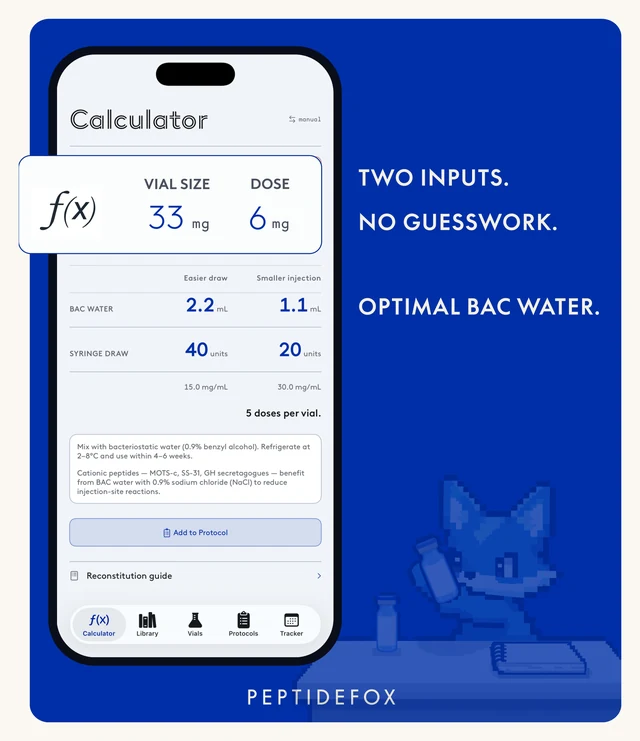
Simply enter vial size & dose — PeptideFox's peptide reconstitution calculator auto-solves BAC water volume (mL) for clean and accurate syringe-unit draws — with compound-specific reconstitution guidance to minimize injection site irritation.
Switch to manual mode to calculate dosage in syringe units for already reconstituted vials by entering vial size, concentration, and desired dose in milligrams.
Supports 30+ peptides including BPC-157, Semax, Selank, MOTS-c, SS-31, Tesamorelin, Pinealon, GLP-1s, and NAD+ — along with native support for multi-compound peptide blends.
How does a peptide reconstitution calculator solve BAC water and syringe units?
PeptideFox’s reconstitution calculator takes fixed real-world constraints — vial size & desired dose in milligrams — and applies a dynamic formula to solve the optimal amount of BAC water needed for an easy, round-number syringe draw (such as 10, 20, or 50 units).
The calculator recognizes that human precision is limited by syringe markings and solves the common frustration with peptide reconstitution — no more guessing if 1.33 mL or 2.5 mL is the "correct" amount of BAC water, or working out how many syringe units your dose comes to — often a hard-to-read number like 13 or 22.5.
Most other peptide calculators work backward: rather than solving anything, they require the user to guess and input their own BAC water volume, leading to error-prone dosing.
The PeptideFox calculator does away with all manual reconstitution math by splitting your choices into two clear behavioral profiles while providing the concentration in mg/mL and the injection volume in mL and U-100 syringe units:
- Easier to Measure: Calculates a larger BAC water volume (e.g., 2.5 mL), landing injection draws on a highly visible, easy-to-read syringe tick mark like 50 units.
- Smaller Injection: If you want less fluid under the skin, it drops the automated fluid volume down (e.g., 1 mL) while keeping the final draw locked onto an easy to read number, such as 15 or 20 units.
PeptideFox’s calculator includes presets for more than 30 peptides — including GLP-1s (Retatrutide, Tirzepatide, Semaglutide), GHK-Cu, MOTS-c, SS-31, BPC-157, Semax, Selank, Pinealon — and supporting compounds such as NAD+ and Glutathione.
Each peptide carries default vial sizes, dose ranges, and notes on the correct diluent to reduce injection site reactions. And unlike standard single-entry arithmetic fields, it includes pre-sets for complex multi-peptide blends (e.g. the Wolverine Stack, GLOW) with ratio-locked dosing to an "anchor" compound to solve the correct BAC water amount for the full blend — with zero guesswork.

Reconstitution calculator:
No math required
Unlike other peptide calculators, there is no guesswork.
A calculator should solve unknowns, not just be a worksheet that makes you do the underlying math.
Enter vial size and dose
Input the only two known values: vial size in milligrams and desired dose.
The calculator auto-solves BAC water
Worksheet reconstitution calculators result in impractical values such as 16.67 syringe units — a recipe for inaccurate dosing. The PeptideFox calculator reverses that by deterministically optimizing BAC water volume for clean, easy-to-read syringe draws — 10, 25, 50 units — to reduce human error.
Choose between easier draw or smaller injection
The calculator optimizes both options to land on easy-to-read syringe unit values — and provides concentration in mg/mL as a reference. Works for U-100 syringes of any size.
Read additional info: doses per vial and BAC water type
The output shows how many doses per vial to plan a protocol and which type of BAC water to use to reduce injection site reactions (e.g. NaCl for cationic peptides like MOTS-c, SS-31).
PEPTIDE BLENDS
Reconstitute KLOW, GLOW, the Wolverine Stack —
or any custom blend
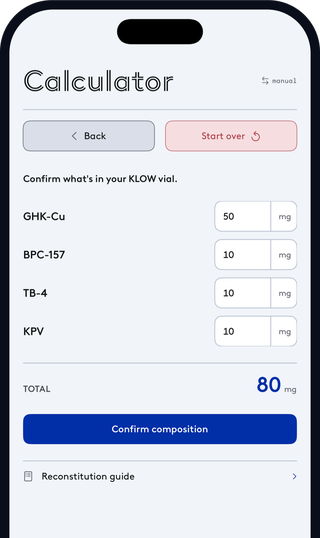
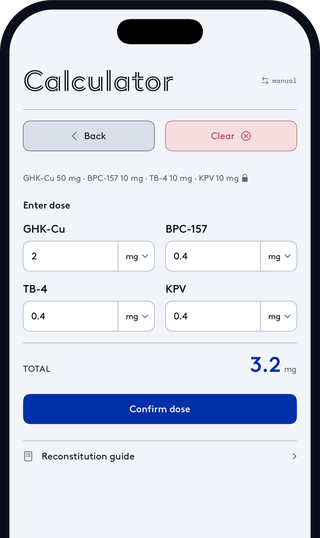
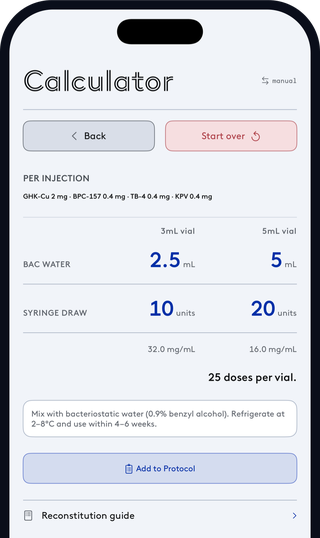
Multi-peptide vials carry compound ratios and higher risk of error. The PeptideFox calculator simplifies blend reconstitution: simply enter the vial mix in milligrams to lock the blend ratio, use an anchor compound to set the desired dose, and it auto-solves the optimal BAC water for an easy-to-read syringe draw and breaks down the per-compound dose per injection. Pre-wired to support the GLOW & KLOW peptide blends, BPC-157+TB-500 stacks, or any custom blend.
Confirm peptide vial mix
Set ratio-locked dose
Auto-solve optimal BAC Water
GPT & Claude hedge.
FoxAI helps inform.

$ For Mounjaro / Zepbound, is the starting dose the same for everyone?...Yes — for the FDA-approved versions, the recommended starting dose is the same for almost everyone. Both Mounjaro and Zepbound contain tirzepatide, and both are started the same way:• 2.5 mg once weekly for the first 4 weeks• then increase to 5 mg once weekly• after that, +2.5 mg every 4 weeks or longer The 2.5 mg dose is meant to help your body adjust and reduce side effects. Most people do not stay at 2.5 mg. The main exceptions are people already taking another GLP-1 or with special clinical circumstances. If you’re about to start, I can explain what side effects are most common during the first month.
$ For Mounjaro / Zepbound, is the starting dose the same for everyone?...No — the label has one official starting dose, but it answers a narrower question than people assume. The official starting dose is 2.5 mg weekly, held for at least four weeks before any increase. That’s a tolerability dose, not a treatment dose — it’s there to let the gut adapt to slower stomach emptying before pushing higher, and it’s the same number whether you’re 150 lb or 280 lb. What it doesn’t account for is body size. Tirzepatide is dosed in flat milligrams, not by weight, so the same 2.5 mg hits harder in a lighter body. A 70 kg person runs meaningfully higher exposure per milligram than a 120 kg person, which is why two people on one dose can have very different first months. So: one labeled starting dose, but not one starting experience. If you’re lighter, lean, or sensitive to GI or heart-rate changes, 2.5 mg can land like a bigger dose than the number suggests.
Reconstitution Math
How are BAC water volume and syringe units calculated for peptide reconstitution and dosing?
To reconstitute any peptide, GLP-1, or supporting compound such as NAD+, divide the total peptide amount in the vial (mg) by the amount of bacteriostatic (BAC) water added (mL) to find the concentration (mg/mL), then divide the desired dose (mg) by this concentration (mg/mL) to determine the injection volume in syringe units.
Peptide Reconstitution Steps
- Start with Vial Size: Identify total milligrams (mg) on the vial (e.g., 2 mg, 5 mg, 10 mg).
- Add BAC Water: Add a precise amount of BAC water, typically 1 mL or 2 mL, to the vial to dissolve the peptide.
- Determine Concentration (example: 10 mg vial ÷ 1 mL water = 10 mg/mL):
Concentration (mg/mL) = Total Peptide (mg)Total BAC Water (mL)
- Calculate Dosage Volume (example: 1 mg dose ÷ 10 mg/mL = 0.1 mL):
Volume to Draw (mL) = Desired Dose (mg)Concentration (mg/mL)
- Convert to Syringe Units: Using a standard U-100 (1 mL/100 unit) insulin syringe, 0.1 mL equals 10 units.
Standard Reconstitution Examples (Targeting 10–50 Units)
- 250 mcg (0.25 mg) dose in a 10 mg vial: Add 1 mL BAC water = 25 units (0.25 mL draw).
- 500 mcg (0.5 mg) dose in a 10 mg vial: Add 2 mL BAC water = 25 units (0.25 mL draw).
- 1 mg dose in a 10 mg vial: Add 2 mL BAC water = 20 units (0.2 mL draw).
- 2.5 mg dose in a 20 mg vial: Add 2 mL BAC water = 25 units (0.25 mL draw).
- 4 mg dose in a 20 mg vial: Add 2 mL BAC water = 40 units (0.4 mL draw).
Key Considerations
- Units vs. mL: 100 units on a syringe equals 1 mL.
- Precision: Use smaller syringes (e.g., 30-unit or 50-unit) for more accurate, smaller doses.
- Reconstitution: Add water slowly down the side of the vial, then gently swirl to dissolve; do not shake.
- Accuracy: Use the FoxAI peptide calculator to automatically double-check calculations and conversions.
How are milligrams (mg) converted to micrograms (µg) for peptide dosing?
Multiply milligrams (mg) by 1,000 to get micrograms (mcg). For example, 2 mg is equal to 2,000 mcg.
Most healing peptides (BPC-157, TB-500) and neuro peptides (Semax, Selank) are dosed in mcg (250–500 mcg).
Which syringe types are commonly used for peptide injections?
Insulin syringes (0.3 mL, 0.5 mL, or 1 mL, 29–31 gauge) are standard for subcutaneous peptide injections. They’re marked in units where 100 units = 1 mL. PeptideFox’s calculator shows both unit and mL measurements.
For the reconstitution step itself — drawing the BAC water and adding it to the vial — use a larger 3–5 mL syringe with a 23–27 gauge needle. The bigger barrel pulls the full water volume in one draw, requiring only one piercing of the vial to keep contamination risk low. Switch to the 28–31 gauge insulin syringe for the actual injection.
What happens when too much bacteriostatic water is added?
Nothing is ruined — it is just a lower concentration, which means a larger injection volume to hit the same dose.
Update the BAC water field in the calculator and it will recalculate automatically. The peptide is unaffected — dilution changes the volume per dose, not the compound.
How are peptide milligrams (mg) converted to U-100 insulin syringe units?
Step 1 — calculate your peptide vial’s concentration in mg/mL. Use this formula:
Concentration (mg/mL) = Vial Size (mg)BAC Water (mL)
Example: a 10 mg vial reconstituted with 2 mL of BAC water yields 5 mg/mL.
Step 2 — convert your dose into syringe units. On a U-100 syringe, 1 mL = 100 units.
Syringe Units = Desired Dose (mg)Concentration (mg/mL) × 100
Example: a 0.5 mg dose at 5 mg/mL = (0.5 ÷ 5) × 100 = 10 units.
Standard Insulin Syringe Capacities
- 0.3 mL Syringe: 30 units max — ideal for small, precise doses under 30 units.
- 0.5 mL Syringe: 50 units max — ideal for standard 25–50 unit doses.
- 1.0 mL Syringe: 100 units max — ideal for large reconstitution volumes or doses over 50 units.
- 3.0 mL Syringe: 300 units max — ideal for larger intramuscular injections for NAD+, Glutathione, and other support compounds.
3 mL syringes are also used for reconstitution to avoid multiple transfers between BAC water and peptide vials.
How is BAC water volume determined for less common doses or non-standard vial sizes?
When a dose doesn’t divide cleanly into the total milligrams in the vial, adjust the water volume to force the math. Adding a precise, uneven amount of water (like 2.4 mL) ensures your daily injection always lands on a clean 10- or 50-unit mark, minimizing dosing errors. PeptideFox’s FoxAI calculator dynamically solves this for you, eliminating any guesswork and reducing human error risk.
Steps to Force Clean Syringe Math
Set target syringe units. Lock your desired draw to a round number, such as 10 units (0.1 mL), 25 units (0.25 mL) or 50 units (0.5 mL).
Apply the reconstitution formula. Multiply the vial size by the target volume, then divide by the desired dose.
Ideal BAC Water (mL) = Vial Size (mg) × Target Volume (mL)Desired Dose (mg)
Examples for Tricky Reconstitutions
- 400 mcg (0.4 mg) dose in a 10 mg vial: Target 10 units (0.1 mL). Add 2.5 mL BAC water.
- 2.2 mg dose from a 20 mg vial: Target 25 units (0.25 mL). Add 2.27 mL BAC water.
- 750 mcg (0.75 mg) dose in a 10 mg vial: Target 20 units (0.2 mL). Add 2.66 mL BAC water.
- 2.5 mg dose in a 12 mg vial: Target 50 units (0.5 mL). Add 2.4 mL BAC water.
- 5 mg dose in a 24 mg vial: Target 50 units (0.5 mL). Add 2.4 mL BAC water.
Other Peptides
How are BAC water volume and syringe units calculated for a vial of MOTS-c?
MOTS-c triggers the same cellular response as an endurance session — shifting metabolism toward fat oxidation. A 5 mg to 10 mg dose injected prior to exercise is standard for maximizing this metabolic adaptation.
Reconstitution note: Use 0.9% NaCl Bacteriostatic Water, not plain BAC water. MOTS-c frequently causes injection-site welts; sodium chloride dampens this localized skin reaction. Use the reconstituted vial within 2 weeks.
Reconstitute for clean math. Add 1 mL of 0.9% NaCl bacteriostatic water to the 10 mg vial.
Concentration = Total Peptide (mg)BAC Water (mL) = 10 mg1 mL = 10 mg/mL
Calculate your draw volume. For a 5 mg target dose:
Volume to Draw = Desired DoseConcentration = 5 mg10 mg/mL = 0.5 mL
Convert to syringe units. On a U-100 insulin syringe, 1 mL = 100 units.
Syringe Units = Volume to Draw (mL) × 100 = 0.5 mL × 100 = 50 units
MOTS-c Reconstitution & Dosing Profile (10 mg Vial / 1 mL BAC Water)
- 5 mg Dose: Draw 50 units (0.5 mL).
- 10 mg Dose: Draw 100 units (1.0 mL).
MOTS-c Reconstitution & Dosing Profile (20 mg Vial / 2 mL BAC Water)
- 5 mg Dose: Draw 50 units (0.5 mL).
- 10 mg Dose: Draw 100 units (1.0 mL).
How are BAC water volume and syringe units calculated for a vial of NAD+?
NAD+ drives cellular energy and mitochondrial function. At 50 mg to 200 mg per dose, the high injection volume requires intramuscular (IM) administration or splitting the dose across multiple subcutaneous sites.
Reconstitution note: NAD+ is acidic, and that acidity is the main driver of injection-site sting. The fix is to buy a buffered version of NAD+, so source it pre-buffered when you can. Reconstitute it with BAC water containing sodium chloride (NaCl) to reduce welting; NaCl eases the osmotic discomfort but does not correct the acidity.
Reconstitute for clean math. Choose your vial size — each lands at the same working concentration:
- 250 mg NAD+ vial: Add 2.5 mL → 100 mg/mL.
- 500 mg NAD+ vial: Add 5 mL → 100 mg/mL.
- 1,000 mg NAD+ vial: Add 5 mL → 200 mg/mL.
Concentration = Total Peptide (mg)BAC Water (mL) = 250 mg2.5 mL = 100 mg/mL
Calculate your draw volume. For a 100 mg target dose at 100 mg/mL:
Volume to Draw = Desired DoseConcentration = 100 mg100 mg/mL = 1.0 mL
Convert to syringe units. On a U-100 insulin syringe, 1 mL = 100 units.
Syringe Units = Volume to Draw (mL) × 100 = 1.0 mL × 100 = 100 units
NAD+ Dosing Profile (100 mg/mL Concentration)
- 50 mg Dose: Draw 50 units (0.5 mL).
- 100 mg Dose: Draw 100 units (1.0 mL).
- 150 mg Dose: Draw 150 units (1.5 mL) — requires two syringes or a larger 3 mL IM syringe.
How are BAC water volume and syringe units calculated for a vial of BPC-157?
BPC-157 accelerates healing by directing blood vessel cells to sprout new capillaries into damaged tissue. Patients typically target 250 mcg to 500 mcg injected subcutaneously to support tendon recovery and gut inflammation.
Reconstitute for clean math. Add 2 mL of bacteriostatic water to the 10 mg vial.
Concentration = Total Peptide (mg)BAC Water (mL) = 10 mg2 mL = 5 mg/mL
Calculate your draw volume. For a 500 mcg (0.5 mg) target dose:
Volume to Draw = Desired DoseConcentration = 0.5 mg5 mg/mL = 0.1 mL
Convert to syringe units. On a U-100 insulin syringe, 1 mL = 100 units.
Syringe Units = Volume to Draw (mL) × 100 = 0.1 mL × 100 = 10 units
BPC-157 Dosing Profile (10 mg Vial / 2 mL BAC Water)
- 250 mcg Dose: Draw 5 units (0.05 mL).
- 500 mcg Dose: Draw 10 units (0.1 mL).
How are BAC water volume and syringe units calculated for a vial of TB-500?
TB-500 is a synthetic fraction of Thymosin Beta-4, explicitly favored for acute muscle and tissue repair. Rather than daily injections, the protocol requires a heavier 2.5 mg systemic dose injected twice per week.
Reconstitute for clean math. Add 1 mL of bacteriostatic water to the 10 mg vial.
Concentration = Total Peptide (mg)BAC Water (mL) = 10 mg1 mL = 10 mg/mL
Calculate your draw volume. For a 2.5 mg target dose:
Volume to Draw = Desired DoseConcentration = 2.5 mg10 mg/mL = 0.25 mL
Convert to syringe units. On a U-100 insulin syringe, 1 mL = 100 units.
Syringe Units = Volume to Draw (mL) × 100 = 0.25 mL × 100 = 25 units
TB-500 Dosing Profile (10 mg Vial / 1 mL BAC Water)
- 2.5 mg Dose: Draw 25 units (0.25 mL).
- 5 mg Dose: Draw 50 units (0.5 mL).
How are BAC water volume and syringe units calculated for a vial of Semax?
Semax supports cognitive function and focus by enhancing brain-derived neurotrophic factor (BDNF). It is dosed between 300 mcg and 1,000 mcg (1 mg) daily, either subcutaneously or via an intranasal applicator.
Reconstitute for clean math. Add 2 mL of bacteriostatic water to the 10 mg vial.
Concentration = Total Peptide (mg)BAC Water (mL) = 10 mg2 mL = 5 mg/mL
Calculate your draw volume. For a 1 mg (1,000 mcg) target dose:
Volume to Draw = Desired DoseConcentration = 1 mg5 mg/mL = 0.2 mL
Convert to syringe units. On a U-100 insulin syringe, 1 mL = 100 units.
Syringe Units = Volume to Draw (mL) × 100 = 0.2 mL × 100 = 20 units
Semax Dosing Profile (10 mg Vial / 2 mL BAC Water)
- 300 mcg Dose: Draw 6 units (0.06 mL).
- 1 mg (1,000 mcg) Dose: Draw 20 units (0.2 mL).
How are BAC water volume and syringe units calculated for a vial of Selank?
Selank is a tuftsin-derived anxiolytic that modulates GABA signaling and dampens inflammation, used for stress resilience and focus. It is dosed at 250 mcg to 500 mcg daily, either subcutaneously or through an intranasal applicator.
Reconstitute for clean math. Add 2 mL of bacteriostatic water to the 10 mg vial.
Concentration = Total Peptide (mg)BAC Water (mL) = 10 mg2 mL = 5 mg/mL
Calculate your draw volume. For a 500 mcg (0.5 mg) target dose:
Volume to Draw = Desired DoseConcentration = 0.5 mg5 mg/mL = 0.1 mL
Convert to syringe units. On a U-100 insulin syringe, 1 mL = 100 units.
Syringe Units = Volume to Draw (mL) × 100 = 0.1 mL × 100 = 10 units
Selank Dosing Profile (10 mg Vial / 2 mL BAC Water)
- 250 mcg Dose: Draw 5 units (0.05 mL).
- 500 mcg Dose: Draw 10 units (0.1 mL).
For the nasal route, reconstitute with BAC water containing NaCl rather than plain BAC water — benzyl alcohol alone irritates the nasal lining. N-Acetyl Selank Amidate carries end-chain modifications that raise stability and bioavailability; users often dose it lower or less often than the unmodified form. Reconstituted Selank holds 4–6 weeks refrigerated, away from light.
How are BAC water volume and syringe units calculated for a vial of GHK-Cu?
GHK-Cu is a copper-binding peptide that up-regulates collagen and elastin synthesis while down-modulating matrix metalloproteinases (MMPs), driving skin remodeling and connective-tissue repair. Systemic tissue-repair dosing runs 1 mg to 2.5 mg subcutaneously, three times per week. The reconstituted solution reads blue — that color is the copper complex and is normal.
Reconstitute for clean math. Add 2.5 mL of bacteriostatic water to the 50 mg vial.
Concentration = Total Peptide (mg)BAC Water (mL) = 50 mg2.5 mL = 20 mg/mL
Calculate your draw volume. For a 2 mg target dose:
Volume to Draw = Desired DoseConcentration = 2 mg20 mg/mL = 0.1 mL
Convert to syringe units. On a U-100 insulin syringe, 1 mL = 100 units.
Syringe Units = Volume to Draw (mL) × 100 = 0.1 mL × 100 = 10 units
GHK-Cu Dosing Profile (50 mg Vial / 2.5 mL BAC Water)
- 1 mg Dose: Draw 5 units (0.05 mL).
- 2 mg Dose: Draw 10 units (0.1 mL).
How are BAC water volume and syringe units calculated for a vial of Tesamorelin?
Tesamorelin is a stabilized GHRH analog that stimulates pituitary growth-hormone release, raising IGF-1 and driving visceral-fat lipolysis. It is dosed at 1 mg to 2 mg daily, subcutaneously.
Reconstitution note: Tesamorelin is strongly cationic and prone to injection-site welts, so reconstitute with 0.9% NaCl bacteriostatic water rather than plain BAC water — the sodium and chloride ions screen the peptide’s charge and shrink the welt. Its FDA label specifies sterile water, but that is regulatory convention, not the gentler diluent.
Reconstitute for clean math. Add 2 mL of 0.9% NaCl bacteriostatic water to the 10 mg vial.
Concentration = Total Peptide (mg)BAC Water (mL) = 10 mg2 mL = 5 mg/mL
Calculate your draw volume. For a 2 mg target dose:
Volume to Draw = Desired DoseConcentration = 2 mg5 mg/mL = 0.4 mL
Convert to syringe units. On a U-100 insulin syringe, 1 mL = 100 units.
Syringe Units = Volume to Draw (mL) × 100 = 0.4 mL × 100 = 40 units
Tesamorelin Dosing Profile (10 mg Vial / 2 mL BAC Water)
- 1 mg Dose: Draw 20 units (0.2 mL).
- 2 mg Dose: Draw 40 units (0.4 mL).
How are BAC water volume and syringe units calculated for a vial of Sermorelin?
Sermorelin is a GHRH fragment that triggers pulsatile growth-hormone release from the pituitary with a modest IGF-1 rise. It is dosed at 200 mcg to 500 mcg daily, subcutaneously — typically at night to align with the body’s natural GH pulse.
Reconstitution note: As a cationic GH secretagogue, sermorelin reconstitutes better in 0.9% NaCl bacteriostatic water, which dampens the charge-driven injection-site welt.
Reconstitute for clean math. Add 2 mL of 0.9% NaCl bacteriostatic water to the 10 mg vial.
Concentration = Total Peptide (mg)BAC Water (mL) = 10 mg2 mL = 5 mg/mL
Calculate your draw volume. For a 500 mcg (0.5 mg) target dose:
Volume to Draw = Desired DoseConcentration = 0.5 mg5 mg/mL = 0.1 mL
Convert to syringe units. On a U-100 insulin syringe, 1 mL = 100 units.
Syringe Units = Volume to Draw (mL) × 100 = 0.1 mL × 100 = 10 units
Sermorelin Dosing Profile (10 mg Vial / 2 mL BAC Water)
- 300 mcg Dose: Draw 6 units (0.06 mL).
- 500 mcg Dose: Draw 10 units (0.1 mL).
How are BAC water volume and syringe units calculated for a vial of Thymosin Alpha-1?
Thymosin Alpha-1 (Tα1) is an immune-modulating peptide that enhances T-cell function, upregulates MHC expression, and rebalances the Th1/Th2 response — used for immune support and post-viral recovery. It is dosed around 1.6 mg daily, subcutaneously.
Reconstitute for clean math. Add 2.5 mL of bacteriostatic water to the 10 mg vial.
Concentration = Total Peptide (mg)BAC Water (mL) = 10 mg2.5 mL = 4 mg/mL
Calculate your draw volume. For a 1.6 mg target dose:
Volume to Draw = Desired DoseConcentration = 1.6 mg4 mg/mL = 0.4 mL
Convert to syringe units. On a U-100 insulin syringe, 1 mL = 100 units.
Syringe Units = Volume to Draw (mL) × 100 = 0.4 mL × 100 = 40 units
Thymosin Alpha-1 Dosing Profile (10 mg Vial / 2.5 mL BAC Water)
- 0.8 mg Dose: Draw 20 units (0.2 mL).
- 1.6 mg Dose: Draw 40 units (0.4 mL).
- 3.2 mg Dose: Draw 80 units (0.8 mL).
Reconstitution & Storage
Why is vigorous shaking not recommended when dissolving a peptide?
Shaking looks faster, but it forces the air above the powder into the liquid as foam, and you have to wait for that foam to settle before you can draw — so it doesn’t save time. Foam is mostly a dosing problem: you can’t pull an accurate volume through bubbles, and some peptide gets held up in it. Vigorous agitation can also destabilize protein and peptide solutions. Swirl gently or roll the vial instead when the product instructions permit it.¹ ²
When is sterile water used instead of bacteriostatic water for peptide reconstitution?
Bacteriostatic Water for Injection is a multiple-dose diluent containing 0.9% benzyl alcohol; preservative-free sterile water is generally supplied for single-dose use. They are not interchangeable by default. Use only the diluent specified by the manufacturer or dispensing pharmacy.¹³ ¹⁴
How is peptide contamination reduced during reconstitution and handling?
Wipe the rubber stoppers with alcohol and let them dry before each pierce, use a fresh sterile needle and syringe every time, and work in a clean preparation area. A preservative can limit some bacterial growth, but it does not replace aseptic technique or make a contaminated vial safe.¹³ ¹⁴
Why are peptide vials allowed to warm before reconstitution?
Yes. Reconstituting straight from the freezer stresses the peptide. Let a frozen vial reach refrigerator temperature (30–60 minutes) first; let a refrigerated vial sit at room temperature for 5–10 minutes. Never add water to a still-frozen peptide.
Are reconstituted peptides suitable for freezing?
No. Lyophilized powder freezes fine for long-term storage, but once a peptide is in solution, ice crystals physically damage the structure — you lose potency and get precipitation on thaw. Refrigerate reconstituted vials; do not freeze them.
What signs indicate that a peptide has degraded?
Watch for cloudiness, visible particles or precipitate, a color shift (most peptides are colorless — GHK-Cu is the exception and reads blue, which is normal), or foam that will not settle. Diminishing results despite consistent dosing is another signal. When in doubt, discard and reconstitute fresh.
How are U-100 insulin syringe markings read for peptide dosing?
Most peptide users inject with U-100 insulin syringes, where 100 units = 1 mL. Read your draw against these conversions:
| U-100 Syringe Units | mL Equivalent |
|---|---|
| 5 units | 0.05 mL |
| 10 units | 0.1 mL |
| 25 units | 0.25 mL |
| 50 units | 0.5 mL |
| 100 units | 1 mL |
The key conversion: 10 units = 0.1 mL. For doses under 20 units, a 0.3 mL or 0.5 mL syringe with 1-unit markings gives better precision than a 1 mL syringe marked in 2-unit steps.
How long do reconstituted peptides remain stable?
There is no universal storage window for every peptide or formulation. Follow the manufacturer label or pharmacy beyond-use date. For opened multi-dose vials without a different manufacturer date, CDC summarizes USP guidance as 28 days after first puncture.¹ ² ¹⁴
What refrigeration is required for reconstituted peptides?
Storage requirements are product-specific. Follow the manufacturer label or dispensing pharmacy instructions for temperature, light exposure, and beyond-use date; do not assume every reconstituted peptide has the same refrigeration or freezing requirements.¹ ²
Injection Guidance
How do plain, saline, and buffered bacteriostatic water differ for peptide reconstitution?
Most peptides reconstitute with standard BAC water. The exceptions come down to what irritates the injection site.
Cationic, amphiphilic peptides that tend to welt reconstitute better in BAC water with 0.9% NaCl: SS-31, MOTS-c, the GH secretagogues (sermorelin, ipamorelin, tesamorelin, CJC-1295), and VIP and kisspeptin-10. These peptides activate MRGPRX2, a mast-cell receptor that fires on positively charged, aromatic molecules and releases histamine into the tissue.⁴ ⁵ Sodium and chloride ions screen the peptide’s positive charge, so the receptor sees less of it and the welt shrinks. Efficacy is unaffected — once the peptide reaches the bloodstream it sits in the body’s own roughly 150 mM saline regardless of what you mixed it with.⁶
NAD+ is different: its pain is acidity, not mast cells — reconstituted NAD+ sits near pH 3.5. NaCl helps the osmotic component, but a buffered version of NAD+ addresses the actual cause.⁹ Tesamorelin is the one people get backwards: its FDA label specifies sterile water, but that is regulatory convenience, not the better diluent. By charge it is the most cationic peptide in this group, so the NaCl logic applies to it most of all.
One storage trade-off: NaCl can speed aggregation in the vial over weeks.⁷ ⁸ Mix smaller amounts and use within 1–2 weeks.
Why do some peptides sting or leave a welt at the injection site?
Skin mast cells carry MRGPRX2, a receptor that fires on cationic, aromatic ("cationic amphiphilic") molecules and releases histamine — redness, swelling, the classic wheal.⁴ ⁵ It is confirmed for SS-31, which activates the receptor well below its injection concentration; blocking the receptor sharply reduces the swelling.⁶ Switching to NaCl BAC water dampens these charge-driven welts. NAD+ is the exception — its sting is acidity-driven, so NaCl helps only the osmotic part and buffering the pH helps more.⁹
How does injection site affect repair-peptide distribution, and does proximity to an injury matter?
For the repair peptides, mostly not. Small peptides enter the bloodstream within minutes of a subcutaneous injection,¹⁰ ¹² and compounds like BPC-157 and GHK-Cu act through gene-signaling cascades that work body-wide rather than only where the needle went. No study has compared injecting near an injury against injecting elsewhere for these compounds — "inject near the injury" is a reasonable, low-cost default, but it is practitioner convention, not an evidence-backed advantage. The one honest exception: TB-500 works partly by mass-action, so a higher local concentration in the brief window before it disperses is at least plausible. The abdomen tends to absorb faster than the thigh because of blood flow, not because it targets anything locally.¹¹
Peptide Reconstitution and Dosing Reference Chart
Each row is a vial size; each column is a target dose per injection. Cells show the bacteriostatic water (BAC) volume to add to the vial and the resulting draw in U-100 insulin syringe units (100 units = 1 mL).
Easier to Measure (Larger, clearer syringe units)
| Vial Size | 0.5 mg dose | 1.0 mg dose | 2.5 mg dose | 5.0 mg dose |
|---|---|---|---|---|
| 5 mg | + 3.0 mL BAC → 30 units | + 2.5 mL BAC → 50 units | + 1.0 mL BAC → 50 units | + 1.0 mL BAC → 100 units |
| 10 mg | + 3.0 mL BAC → 15 units | + 3.0 mL BAC → 30 units | + 3.0 mL BAC → 75 units | + 1.0 mL BAC → 50 units |
| 15 mg | + 3.0 mL BAC → 10 units | + 3.0 mL BAC → 20 units | + 3.0 mL BAC → 50 units | + 3.0 mL BAC → 100 units |
| 20 mg | + 2.4 mL BAC → 6 units | + 3.0 mL BAC → 15 units | + 2.4 mL BAC → 30 units | + 3.0 mL BAC → 75 units |
| 30 mg | + 3.0 mL BAC → 5 units | + 3.0 mL BAC → 10 units | + 3.0 mL BAC → 25 units | + 3.0 mL BAC → 50 units |
Smaller Injection (Less fluid, higher concentration)
| Vial Size | 0.5 mg dose | 1.0 mg dose | 2.5 mg dose | 5.0 mg dose |
|---|---|---|---|---|
| 5 mg | + 1.0 mL BAC → 10 units | + 1.0 mL BAC → 20 units | + 1.0 mL BAC → 50 units | + 1.0 mL BAC → 100 units |
| 10 mg | + 2.0 mL BAC → 10 units | + 1.0 mL BAC → 10 units | + 1.0 mL BAC → 25 units | + 1.0 mL BAC → 50 units |
| 15 mg | + 3.0 mL BAC → 10 units | + 1.5 mL BAC → 10 units | + 1.2 mL BAC → 20 units | + 1.2 mL BAC → 40 units |
| 20 mg | + 2.0 mL BAC → 5 units | + 2.0 mL BAC → 10 units | + 1.2 mL BAC → 15 units | + 1.0 mL BAC → 25 units |
| 30 mg | + 3.0 mL BAC → 5 units | + 3.0 mL BAC → 10 units | + 1.2 mL BAC → 10 units | + 1.2 mL BAC → 20 units |
References
¹ Wang W. Instability, stabilization, and formulation of liquid protein pharmaceuticals. Int J Pharm 1999. PubMed (PMID: 10482990)
² Manning MC, Chou DK, Murphy BM, et al. Stability of protein pharmaceuticals: an update. Pharm Res 2010. DOI: 10.1007/s11095-009-0045-6
³ United States Pharmacopeia. General Chapter <797>, Pharmaceutical Compounding—Sterile Preparations. USP <797> overview
⁴ MRGPRX2: a multifaceted mast-cell receptor for cationic amphiphilic ligands (review). PMC8355064
⁵ Cationic amphiphilic drugs activate MRGPRX2 — pharmacophore modeling and human wheal-and-flare. PMID 33617860
⁶ Elamipretide (SS-31): +3 charge, mitochondrial cardiolipin accumulation, and injection-site-reaction profile (review). PMC9192202
⁷ Oxyntomodulin nanofibril self-assembly — NaCl neutralizes charge repulsion and drives aggregation. Nat Commun 2017. DOI: 10.1038/s41467-017-01114-1
⁸ Formulation strategies for therapeutic peptide stability — pH, ionic strength, co-solvency. PMC10056213
⁹ Subcutaneous injection — osmolality, pH, and volume effects on pain and absorption. PMC6822791
¹⁰ Molecular weight as the main determinant of lymphatic versus capillary absorption after subcutaneous injection. 1990. PMID 2137911
¹¹ Subcutaneous injection-site pharmacokinetics — FDA review. 2021. PMID 34186147
¹² Mechanisms of subcutaneous absorption of therapeutic proteins. 2012. PMC3385825
¹³ DailyMed. Bacteriostatic Water for Injection, USP: multiple-dose diluent with 0.9% benzyl alcohol; use only if clear and the seal is intact. Official prescribing information
¹⁴ Centers for Disease Control and Prevention. Preventing Unsafe Injection Practices: aseptic preparation, new sterile needles and syringes, multi-dose vial handling, and discard guidance. CDC injection-safety guidance
Medical Disclaimer
The content in this calculator is for informational purposes only and does not constitute medical advice. Always consult with a qualified healthcare provider before beginning any new protocol, supplement, or medication.